Reading Your Villa Before It’s Built — A Guide to Floor Plans, Sections, and Elevations
Architectural drawings are a language every villa owner should learn. This guide explains the four essential drawing types — floor plan, section, elevation, and zoning — so you can read them with confidence and make better decisions for your project.
Architectural drawings can feel intimidating. Lines, symbols, numbers, arrows — they form a language that architects speak fluently but clients rarely learn. Yet understanding this language is one of the most valuable investments you can make in your building project. A client who can read a floor plan makes better decisions, asks sharper questions, and ends up with a villa that truly matches their expectations.
This guide explains the four essential drawing types every villa owner should understand: the floor plan, the section, the elevation, and the zoning diagram. Each tells a different part of your building’s story.
THE FLOOR PLAN — THE SPATIAL BLUEPRINT
The floor plan is a bird’s-eye view of your villa, cut horizontally at approximately 1.2m above floor level. It shows walls, doors, windows, stairs, and the relationship between rooms. When you read a floor plan, focus on three things: proportion, circulation, and orientation.
Proportion matters more than total area. A 30 sqm living room can feel cramped if its width-to-length ratio exceeds 1:2. A good floor plan keeps rooms roughly square or gently rectangular — never a narrow corridor disguised as a room. Check the dimensions printed alongside each room label: a living room labelled 6.5m by 5.0m tells you the space is generous and usable.
Circulation is the invisible cost of every floor plan. Corridors, passages, and circulation zones consume square metres without adding usable room. A well-planned villa keeps circulation efficient — 1,200mm to 1,500mm wide, never wasted. Look at how you would walk from the entry to the living room to the master suite. Does the path feel natural? Does it pass through spaces or squeeze along walls?
Orientation determines comfort. The north arrow on every floor plan tells you which rooms face morning sun (east), afternoon heat (west), or remain shaded (south in the southern hemisphere). In Indonesia, the best living spaces face north or south to avoid low-angle east-west sun. Bedrooms can face east for morning light. Service areas work well on the west side.
THE SECTION — THE VERTICAL STORY
While the floor plan shows horizontal relationships, the section cut reveals what happens in the vertical dimension. A section is a slice through the building, like cutting a cake to see the layers inside. It shows ceiling heights, roof pitch, floor-to-floor relationships, and how the building meets the ground.
Section drawings answer questions the floor plan cannot: Will the double-height living room feel grand or overwhelming? How deep are the roof overhangs that protect your windows from tropical rain? Does the floor level step down to follow the natural slope, or is the site artificially flattened? In a well-designed tropical villa, sections validate cross-ventilation paths — air enters low on one side and exits high on the opposite side, creating natural cooling without mechanical systems.
Look for the section cut line on the floor plan; it is typically marked A-A or B-B. Cross-reference the two drawings. If the floor plan shows a 6m-wide living room, the section should show the corresponding ceiling height — typically 3.0m to 3.6m for a single-height space, or up to 5.5m for a double-volume room.
THE ELEVATION — THE FACE OF YOUR VILLA
An elevation drawing shows the exterior of your villa as seen from one direction — front, rear, left, or right. It is the only drawing type that reveals how your building will look from the street, the garden, or the neighbour’s property. Elevations show material transitions (stone base to plaster wall to timber screen), window and door placements, roof shape, and the overall massing composition.
In the Indonesian tropical context, elevations are particularly important for validating sun-shading strategies. Deep overhangs should cast shadows on glazed openings. External timber screens should appear as layered elements, not flat surfaces. A well-composed elevation reads as a cohesive composition, not an assemblage of unrelated forms.
THE ZONING AND BUBBLE DIAGRAM — THE CONCEPTUAL MAP
Before the floor plan comes the zoning diagram — a conceptual bubble diagram that shows how spaces relate without committing to precise wall locations. Think of it as the outline before the essay. Public zones (living, dining, entry) sit near the front. Private zones (bedrooms, study) retreat to the rear or upper level. Service zones (kitchen, laundry, staff quarters) tuck to the side.
A zoning diagram with arrows shows circulation paths. In a well-designed villa, guests move from entry to living without passing through private areas. Family members move easily between private rooms and shared spaces. Staff access service zones without crossing guest paths. These are the invisible hierarchies that make a house feel effortless to inhabit.
PUTTING IT ALL TOGETHER
When you receive a set of architectural drawings, read them in this order: start with the zoning diagram to understand the conceptual organisation. Then study the floor plan for room proportions and circulation. Cross-reference with the sections to check ceiling heights and vertical relationships. Finally, review the elevations to confirm the villa sits beautifully in its context.
Ask questions at every step. Why is the master suite on the north side? How does morning light enter the living room? Where does the cross-breeze come from? A good architect welcomes these questions because they demonstrate a client who is engaged, not passive.
At Concepta, we generate all four drawing types using Google Gemini’s image model, refined and reviewed by our design team. Every drawing is a draft until approved — no auto-publishing, no unverified visuals. The result is a set of presentation drawings that are consistent, architecturally correct, and tailored to the Indonesian tropical context.
You do not need to become an architect to build a great villa. But learning to read these four drawing types will transform you from a passive client into an active collaborator — and that is when the best architecture happens.

Directly illustrates the floor plan reading portion of the guide, helping clients understand key elements like room layout, circulation, and scale.
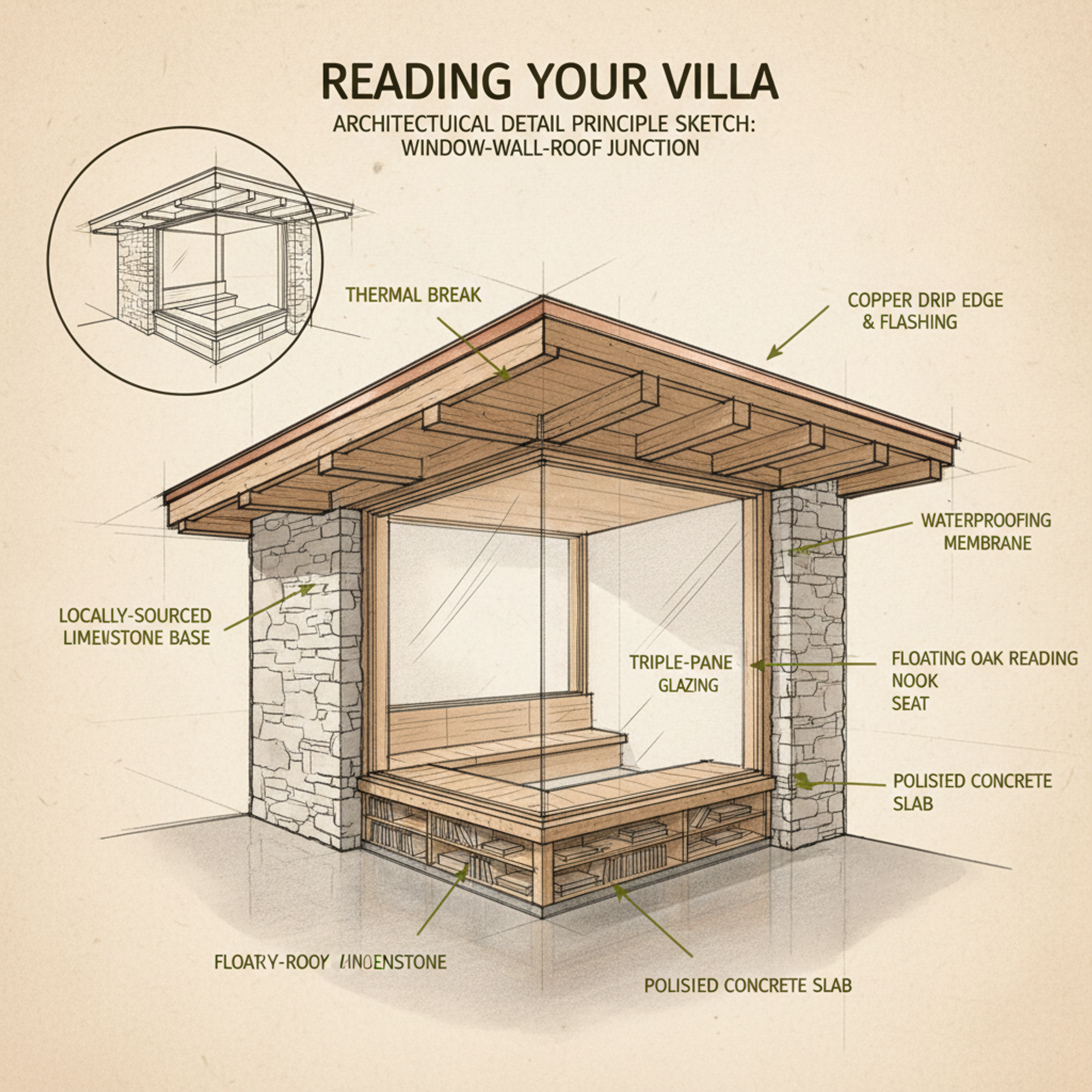
Shows how vertical relationships and interior spaces are conveyed in a section drawing, essential for clients to grasp height, ceiling, and spatial flow.
Related Articles


Concepta Editorial
Concepta Editorial Team
Human reviewed
Have a Project in Mind?
We work selectively with clients who value thoughtful, intelligent architecture.
Start a Conversation