Silence in Architecture — Why the Quietest Houses Feel the Most Luxurious
Luxury in architecture is not what is added — it is what is removed. The quietest spaces are not empty; they are edited with precision.
In this article
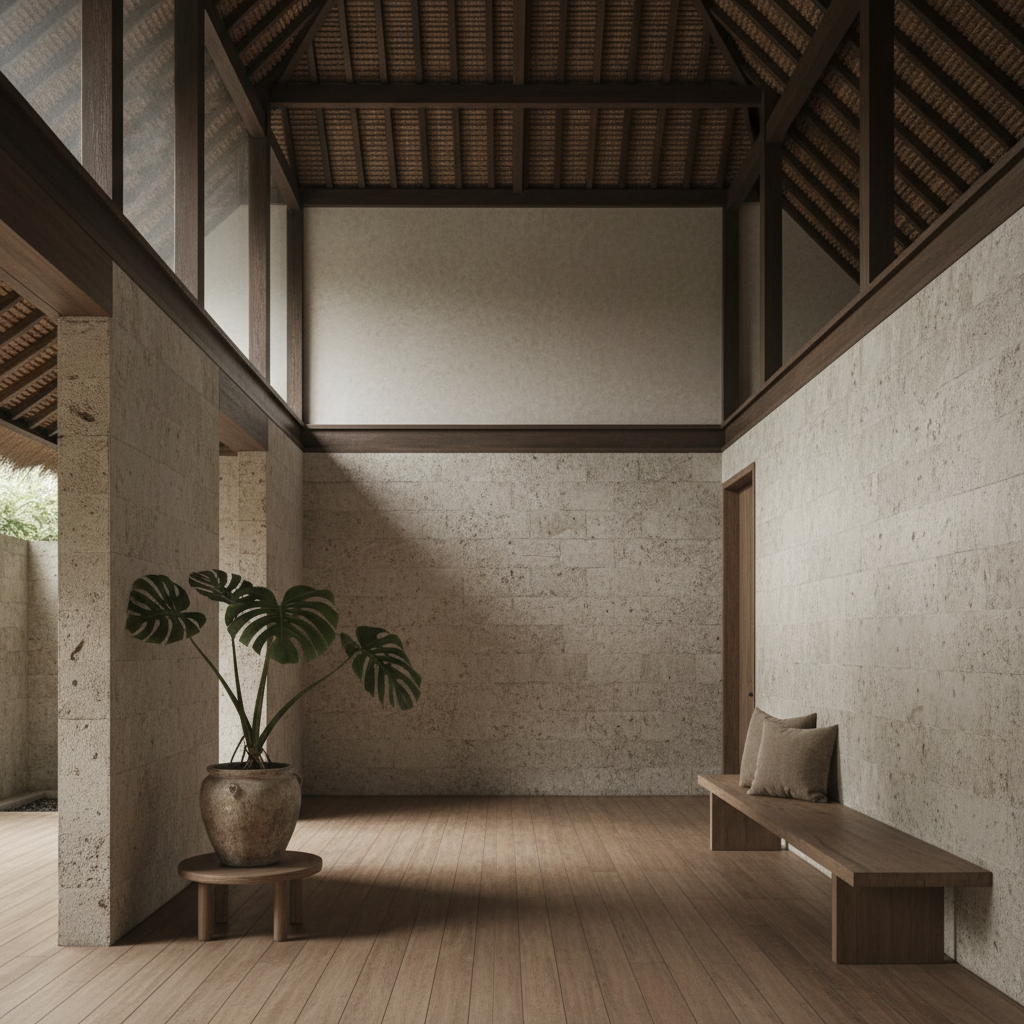
In Indonesian cities, silence is a rare commodity. The quietest houses are those designed to filter sound, edit visual clutter, and create spaces where every element has been chosen with precision.

Quiet luxury material palette: warm natural materials that create a calm, tactile atmosphere. Exposed timber, natural stone, limewash plaster, terrazzo, and hand-laid tile — materials that age gracefully.
Acoustic Design
The most effective acoustic strategy is spatial: placing buffers between noise sources and quiet zones. Courtyards, service spaces, and corridors insulate living areas from street noise.
Material balance matters: hard surfaces reflect sound, soft surfaces absorb. The quiet luxury approach favours hard surfaces balanced with strategic soft elements.

Atmosphere principles of quiet luxury: the spaces that feel most luxurious are not the most decorated — they are the most carefully proportioned, the most thoughtfully lit, and the most materially sincere.
Visual Silence
Visual silence is achieved through restraint in material palette, elimination of unnecessary trim and mouldings, consistent colour temperature, and concealed storage.
This is not minimalism — it is editing with intention. Removing what distracts so the architecture, material, and light can be appreciated.
The Courtyard as Acoustic Buffer
A courtyard between street and living spaces creates a zone of acoustic transition. Water features add masking sound that covers urban noise without adding information.
This is the most effective passive acoustic strategy available to tropical architecture.
Concepta design process includes acoustic and visual comfort studies as part of the spatial strategy.
The Role of Negative Space
In quiet luxury design, what you leave out matters as much as what you include. Negative space—empty wall surfaces, uncluttered corners, silent transitions between rooms—creates visual breathing room that allows the eye to rest. This restraint is not about minimalism as a style but about clarity of intention. Every element in a quiet luxury home must earn its place. A single well-proportioned window framing a garden view carries more weight than a wall of generic artwork. An empty hallway with beautiful natural light is more luxurious than a corridor lined with decorative objects. The discipline of omission is the hardest skill to master, yet it defines the difference between a decorated house and a serene home.
Craftsmanship and Tactile Experience
Quiet luxury is felt as much as it is seen. The surface of hand-trowelled plaster, the grain of solid timber underfoot, the coolness of natural stone on a warm afternoon—these tactile experiences accumulate into a sense of quality that no photograph can convey. In Indonesian architecture, this tradition of craft runs deep. Local artisans working in timber, stone, and terrazzo produce work of extraordinary quality when given clear design direction. Quiet luxury architecture prioritises these hand-crafted elements over mass-produced finishes, creating homes that reward close attention and age with increasing character rather than growing shabby.
Light as a Material in Quiet Luxury
In quiet luxury architecture, light is treated as a building material with the same importance as timber, stone, or plaster. The quality of light in a room—not the quantity but the quality—defines its atmosphere. Architects achieve this by controlling how light enters: through carefully positioned openings, light shelves that bounce daylight deep into a room, and layered shading that filters harsh tropical sun into soft, diffuse illumination. A room with beautiful light needs no decoration because the light itself is the ornament. In Indonesian architecture, this principle is ancient—the Javanese pendopo is designed around the quality of light filtering through the open structure—yet it remains one of the most sophisticated tools in the contemporary architect's palette. When you walk into a room and feel immediately calm without knowing why, it is almost always because the light has been designed.
Related Articles


Concepta Studio
Architecture studio, Jakarta
Human reviewed
Have a Project in Mind?
We work selectively with clients who value thoughtful, intelligent architecture.
Start a Conversation