Arrival as Experience — Why the First Ten Metres Define Your Home
The first ten metres from street to front door determine how your home feels every single day. Most owners overlook this sequence entirely.
In this article
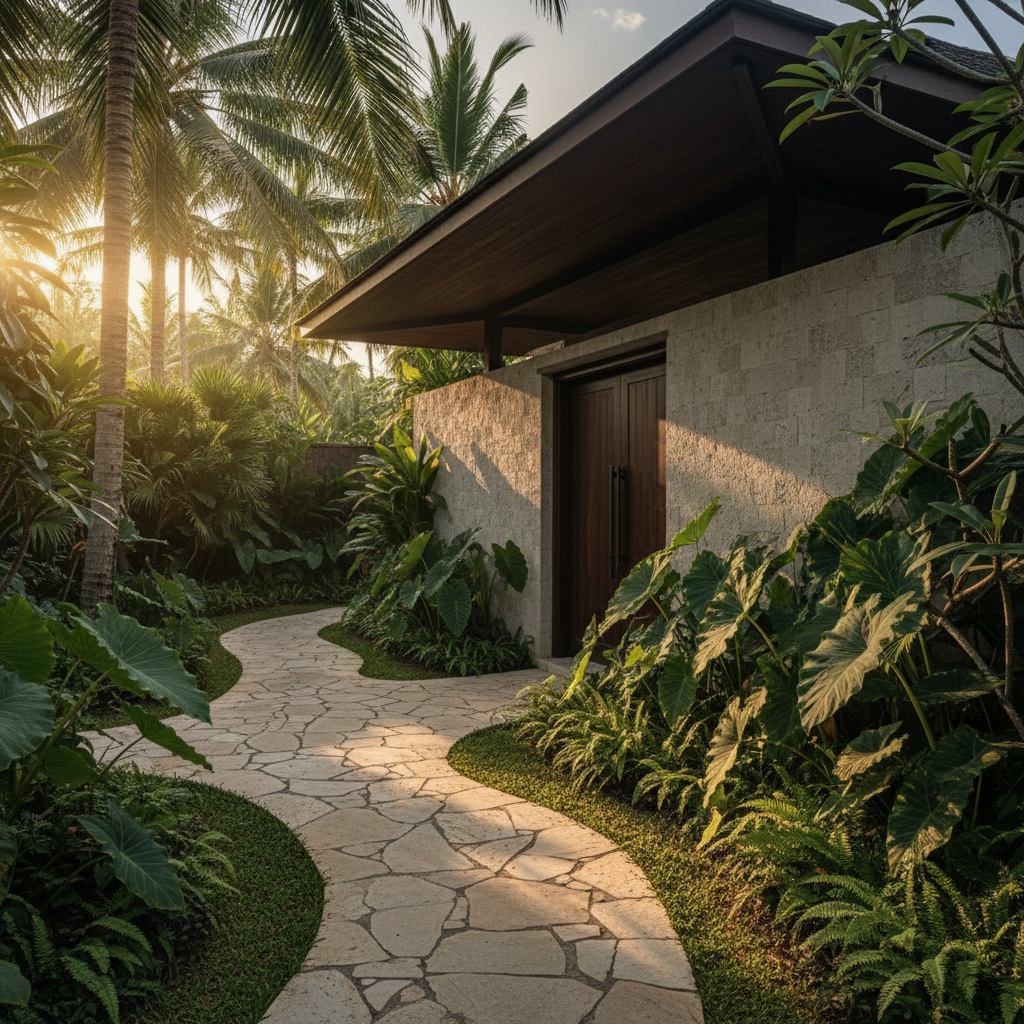
The first ten metres from street to front door determine how your home feels every single day. Yet most home-owners in Indonesia never design this sequence at all. They arrive home through a carport that opens directly into the living room, or through a front gate that offers a clear view of the entire house from the street. The experience of arriving — of transitioning from public street to private sanctuary — is one of the most under-designed moments in contemporary residential architecture.

Privacy gradient from street to sanctuary: each threshold — gate, courtyard, door, entry hall — manages visibility and intimacy for narrow-frontage Indonesian homes.
The Problem with Direct Entry
The most common arrangement in Indonesian urban residences is the direct-entry plan: the front gate opens onto a carport, and the carport connects directly to the living room. This arrangement sacrifices every opportunity for transition. You step out of your car and immediately into family life — no buffer, no decompression, no moment to arrive.
From a privacy perspective, the direct-entry plan is equally problematic. Anyone at the front gate can see into the living room. The boundary between public and private is reduced to a single door.
The problem is not the lack of space — it is the lack of intention. A six-metre frontage can accommodate a gracious arrival sequence if the sequence is designed as a priority rather than as leftover space.
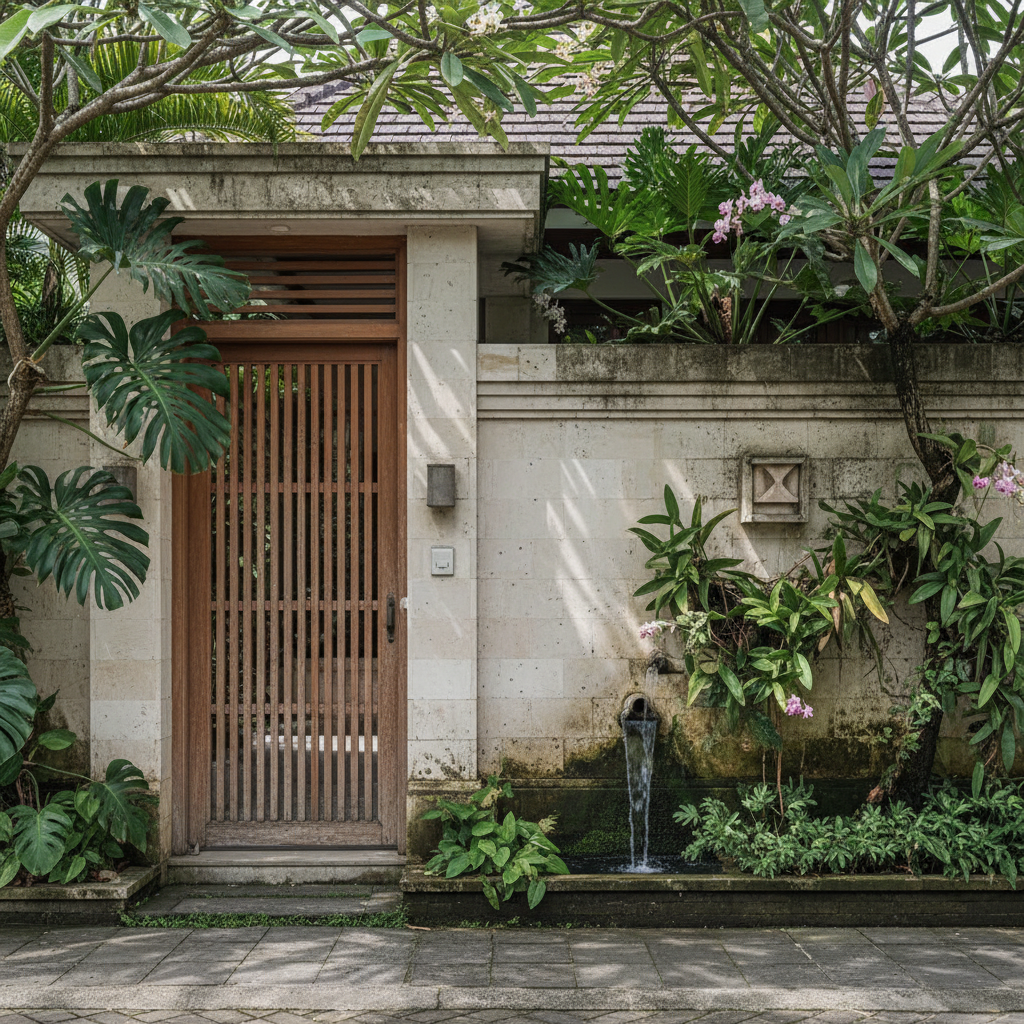
When the front gate opens directly into the living room, every arrival sacrifices privacy and transition.
The Anatomy of Arrival
A well-designed arrival sequence has four distinct moments: approach, transition, greeting, and entry. Each has a specific purpose and a specific spatial quality.
Approach begins at the street. What does the visitor see? A solid gate that hints at what lies beyond without revealing it. In Indonesian residential culture, the gate is the first architectural statement — it should be substantial, considered, and clearly intentional.
Transition is the carport or covered walkway. This is the decompression zone — a protected path that separates the noise of the street from the calm of the home.
Greeting is the covered threshold where arrival culminates. In traditional Indonesian architecture, this was the pendopo or teras — a shaded, generous space where guests were received.
Entry is the final step — the door itself. Its position, width, and relationship to the interior determine whether the sequence resolves gracefully or collapses into confusion.
Privacy and Sightlines
One of the most common mistakes in arrival design is the visual corridor from street to interior. When the front door opens directly onto the living room, the sense of privacy is compromised at every entry and exit.
The solution is not a longer entrance hall — it is a shifted or offset relationship between the door and the primary living space. A wall, a screen, a change in direction that prevents a straight sightline from street to sofa.
In Indonesian urban plots, where neighbours are close and street activity is constant, the visual privacy of the arrival zone is critical. Screening with planting, partial walls, or louvred screens creates a sense of enclosure without sacrificing natural light and air movement.
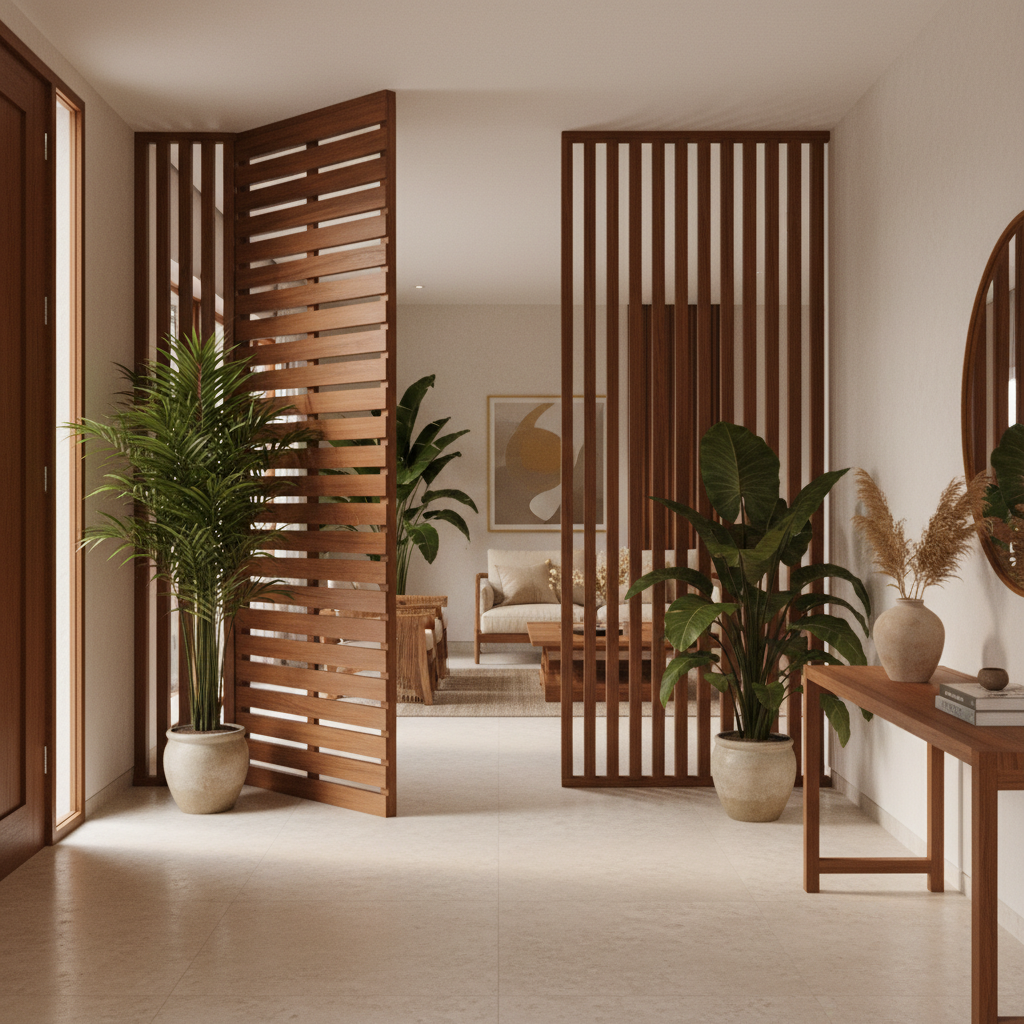
An offset entry sequence prevents a straight sightline from street to sofa.
Narrow Frontage Strategies
For sites with six to eight metres of frontage, every element of the arrival sequence must be compact but deliberate. The key principle is layering.
One effective strategy is the side-entry plan: the carport occupies the front width, but the front door is positioned around a corner or behind a screen. Another is the courtyard approach: a walled garden between the gate and the front door creates a transitional outdoor room.
Materials also play a role. A change from exposed concrete or paving at the carport to stone or timber at the threshold signals the transition visually and physically.
The Threshold as Ritual
The threshold is arguably the most significant architectural moment in the home. In many Indonesian traditions, stepping over the threshold is accompanied by specific rituals — removing shoes, greeting, a moment of pause.
A well-designed threshold provides: a covered area deep enough to stand comfortably while opening the door, a place to set down bags or keys, a material change that signals the transition, and visual screening from the street.
When the threshold is designed with intention, the daily act of coming home becomes a moment of pleasure rather than a functional necessity.
Our initial consultation includes an arrival sequence study — mapping how your family and guests will experience the first ten metres of your home.
Related Articles
Concepta Studio
Architecture studio, Jakarta
Human reviewed
Have a Project in Mind?
We work selectively with clients who value thoughtful, intelligent architecture.
Start a Conversation