Indoor-Outdoor Living — How to Make It Work in High Humidity
Open-plan tropical living that works in dry climates fails in Indonesia. The key is not folding glass walls — it is controlling the gradient of enclosure.
In this article
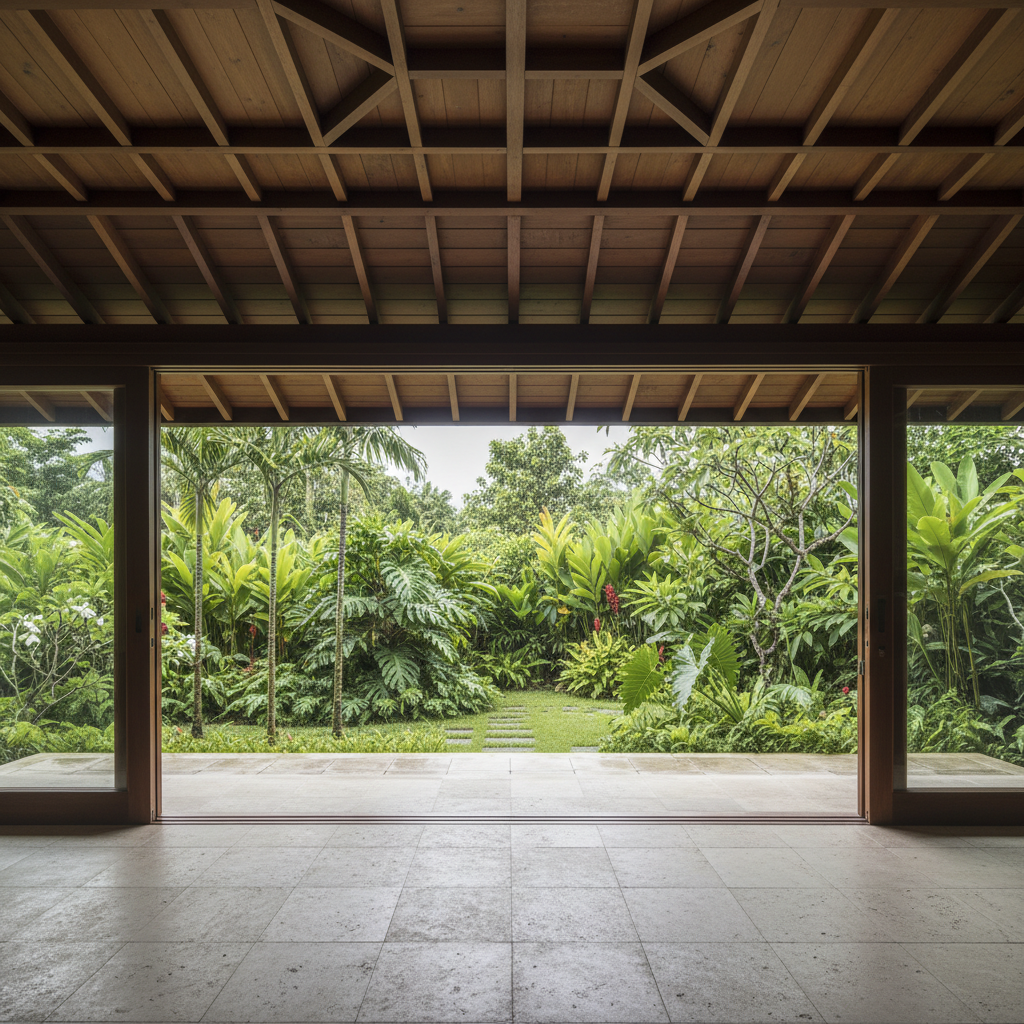
Indoor-outdoor living is the defining promise of tropical architecture. But in Indonesia high-humidity climate, fully open spaces can become unusable during monsoon downpours and oppressively humid during windless afternoons. The solution is to design a gradient of enclosure.

Indoor-outdoor threshold section diagram demonstrating how covered terraces, deep overhangs, and sliding glass walls create a seamless transition between interior and exterior in tropical villas.
The Gradient Strategy
The gradient strategy organises the villa into four zones: conditioned core, semi-conditioned verandah, screened room, and open terrace.
These four zones are arranged in order of enclosure. The occupant can move between them based on time of day, weather, and desired comfort level.
This approach acknowledges that no single space can be comfortable year-round in the tropics — the villa must offer a choice of microclimates.

Circulation separation diagram for tropical villas: guest paths, private family zones, and service circulation routes are carefully separated for privacy and operational efficiency.
The Verandah as Primary Living Space
In the gradient strategy, the verandah — not the living room — becomes the primary daily living space. This is a deliberate inversion of conventional villa planning.
The tropical verandah is a deep, covered, cross-ventilated space positioned between the conditioned core and the open terrace, with openings on at least two sides.
Material Strategy for Humidity
Stone is the most reliable flooring material in humidity. Timber must be selected for tropical durability: teak, bengkirai, or merbau.
The transition between materials — where stone meets timber — is the most important detailing moment in the gradient strategy.
Concepta villa design process begins with a climate gradient study — mapping how each space will perform across the day and seasons.
Managing Light and Glare
One challenge of indoor-outdoor living in the tropics is managing light levels. Too much direct sunlight creates glare and heat gain that make spaces unusable during midday. The solution is layered shading: deep roof overhangs that block high-angle sun, vertical fins or louvers on western exposures, and vegetation that filters light before it reaches the building envelope. The most successful tropical villas create a graduated light transition from bright outdoor spaces through softly lit covered terraces to the cooler interior. This layering of light not only improves comfort but creates the atmospheric richness that distinguishes a well-designed villa from a generic one.
Material Choices for Seamless Transition
The materials used at the indoor-outdoor threshold determine how seamless the transition feels. Flooring that continues from inside to the terrace without a step or material change creates visual continuity that makes both spaces feel larger. In tropical climates, durable materials like exposed aggregate concrete, terrazzo, or large-format porcelain tiles work well for both zones. The ceiling plane should also be considered—a soffit that extends from the interior ceiling to the terrace overhang unifies the two spaces. When materials and planes align, the distinction between inside and outside dissolves, and the entire floor becomes usable living space.
Related Articles
Concepta Studio
Architecture studio, Jakarta
Human reviewed
Have a Project in Mind?
We work selectively with clients who value thoughtful, intelligent architecture.
Start a Conversation