Narrow Frontage, Big Ambition — Designing on Six-Metre Sites
Narrow frontages of 4–8 metres are the default condition for urban low-rise development in Indonesia. The challenge is making the building feel generous on a constrained site.
In this article
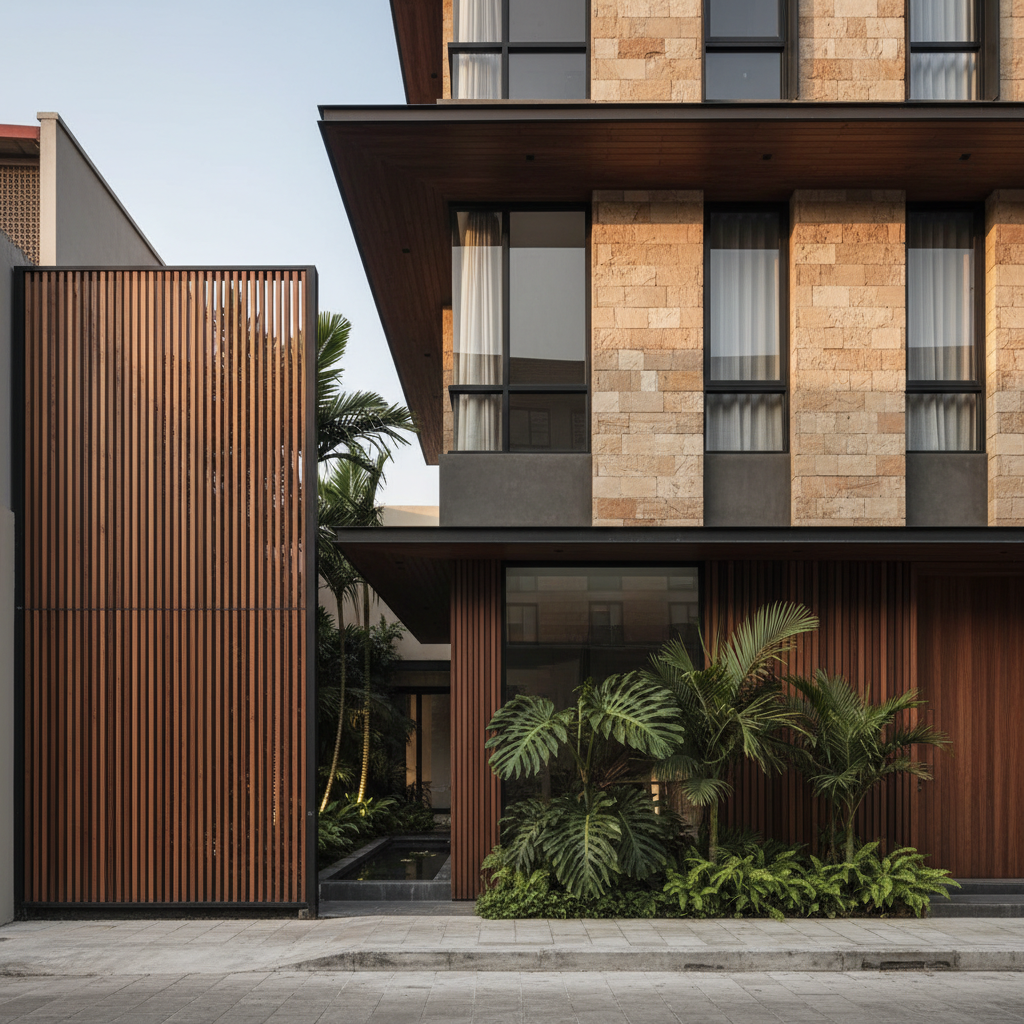
Narrow frontages of four to eight metres are the default condition for boutique low-rise development in Indonesian cities. Success depends on three critical design decisions: the ground-floor strategy, the core position, and the facade treatment.

Massing study for a narrow frontage site (6m wide). The building volumes are stacked and shifted to maximise floor area while maintaining light access, privacy, and street presence.
The Ground-Floor Strategy
On a narrow frontage site, the ground floor is the most constrained and most valuable level. The most successful projects use the ground floor for retail, hospitality, or a generous lobby.
Parking on the ground floor is almost always the wrong answer. It creates a dead frontage and reduces rental value on the most expensive floor.
A car lift liberates the ground floor for revenue-generating use and is more cost-effective than full basement excavation.

Street section showing how a six-metre frontage building relates to the street, adjacent buildings, and the sky. Sun shading and facade rhythm are critical for narrow sites.
Core Position: The Most Important Decision
A rear core maximises frontage flexibility. A side core creates clear-span spaces. A central core is rarely viable on narrow sites.
The core position should be established in the first sketch and never changed. It dictates everything that follows.
Facade Treatment for Narrow Frontages
Vertical proportions are a virtue to be emphasised. Deep overhangs and recessed windows create shadow lines that give depth.
Every material joint must be resolved. Every service element must be integrated from the beginning.
Concepta offers a Site Viability Assessment for narrow-frontage parcels before you commit to a design direction.
Vertical Zoning for Mixed-Use Sites
On narrow frontage sites, vertical zoning becomes the primary design strategy. The ground floor typically accommodates the most public functions: entry, commercial space if permitted, parking, and service areas. The middle floors house the primary living or working spaces where daylight is most valuable, while the top floor can feature a roof terrace that compensates for the lack of ground-level outdoor space. Each floor has a distinct character and relationship to the street, the sky, and the neighbours. Correctly allocating functions across floors is the single most important decision for narrow-site buildings, as it determines both user experience and long-term flexibility.
Privacy Between Neighbours
Narrow sites mean close proximity to neighbours, making privacy a critical design concern. The solution is not to build solid boundary walls but to use strategic openings, offset windows, and vertical screening. Bathrooms and service spaces work well along shared boundaries, while living areas face the front, rear, or an internal lightwell. Operable screens, planter boxes, and textured glass panels provide visual privacy without blocking light or airflow. In Indonesian urban contexts where buildings are often separated by only 50-100 centimetres, thoughtful section planning that staggers window positions between floors can eliminate direct sightlines while maintaining natural ventilation.
Case Study: Six-Metre Site Solutions
Consider a typical six-metre-wide site in a Jakarta residential neighbourhood. The owner wants a ground-floor retail space, two floors of rental apartments, and a rooftop terrace for private use. The conventional approach would be to build a rectangular box filling the entire site width, with a narrow staircase at the rear and windows only on the front and back facades. The architect's approach is different: by setting the building back three metres from the front boundary, a generous entrance courtyard is created that brings light and air to the ground floor. The staircase is moved to the centre of the plan, becoming a light-filled atrium rather than a dark core. Upper-floor apartments are arranged so that each unit has cross-ventilation, achieved by a narrow lightwell on one side and the front facade on the other. The result is a building that feels spacious despite its narrow frontage, with every room receiving natural light and ventilation.
Related Articles

Concepta Studio
Architecture studio, Jakarta
Human reviewed
Have a Project in Mind?
We work selectively with clients who value thoughtful, intelligent architecture.
Start a Conversation