How a Central Courtyard Transforms Privacy in a Tropical Villa
A central courtyard is not merely an aesthetic feature; it is a spatial device that redefines privacy. By turning the house inward, it creates a controlled, serene atmosphere while maintaining connection to light and air.
In this article
A villa in the tropics has one fundamental challenge: how to remain open to the climate while closed to the outside world. The central courtyard resolves this tension. It allows the house to breathe without exposing its inhabitants. When I plan a villa, the courtyard is often the first move I make. It establishes a clear boundary between public and private before a single wall is drawn.
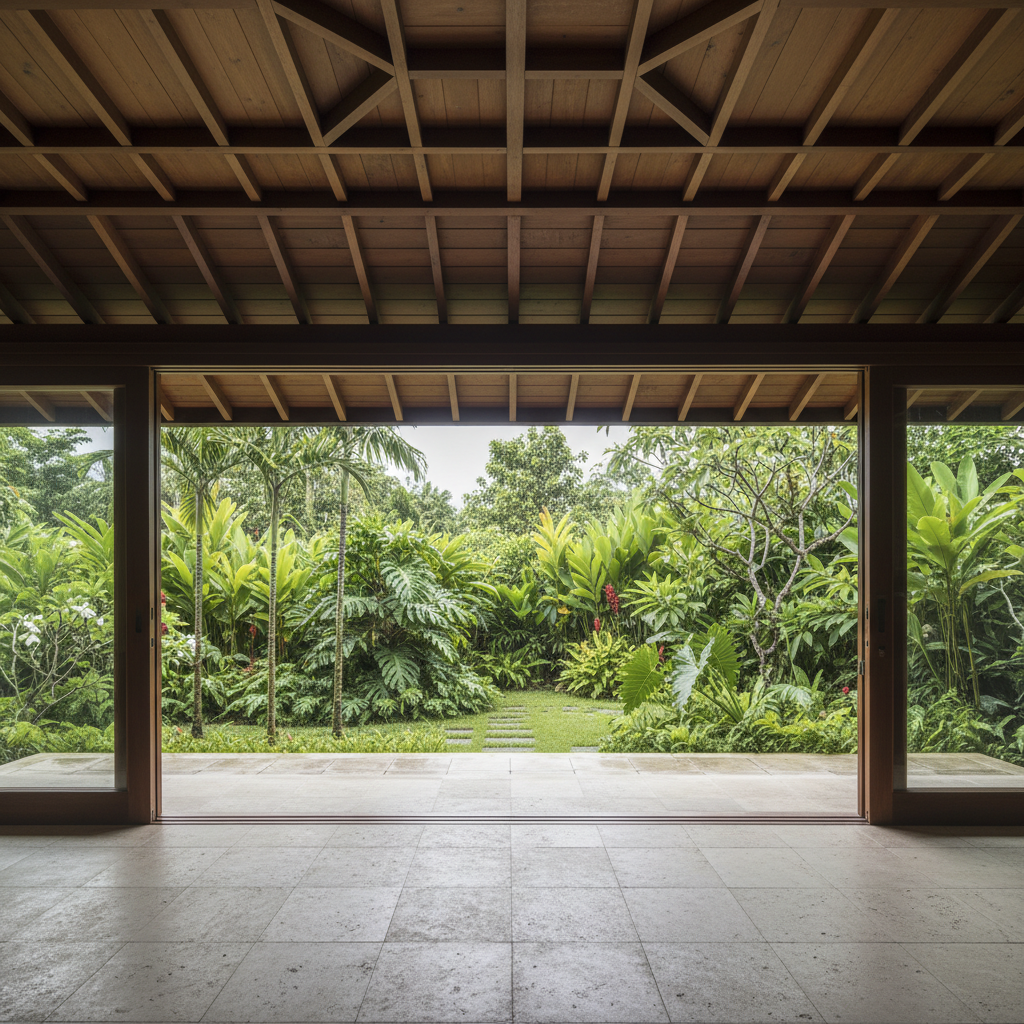
The courtyard works by inverting the typical outward-facing house. Instead of windows looking toward neighboring properties or the street, every room turns inward. This eliminates the need for heavy curtains or high fences. The privacy is built into the plan itself. You can leave sliding doors open all day without feeling observed. The courtyard becomes a private horizon.
Privacy Begins with Orientation
The first decision is where to place the courtyard within the site. I prefer to shift it slightly off-center, so that sightlines from the entrance are oblique rather than direct. You should never see the entire courtyard at once from the gate. A partial view invites curiosity; a full view eliminates mystery. This sequencing of arrival is essential to privacy. It gives the inhabitant a sense of control over what is revealed.
Rooms arranged around the courtyard benefit from layered thresholds. A bedroom might open onto a covered veranda, which steps down into the garden. Each layer adds distance from the outside. The courtyard itself becomes a buffer zone, absorbing sound and visual noise. In dense urban settings, this is invaluable.
Controlled Sightlines, Controlled Atmosphere
A well-designed courtyard manages sightlines vertically as well as horizontally. Overhanging trees or a trellis can filter views from upper floors, ensuring that neighbors cannot look down into the space. Meanwhile, the courtyard floor is kept open to the sky, so the space feels expansive rather than enclosed. The balance between openness and enclosure is what makes the courtyard feel private without feeling claustrophobic.
I also consider how light moves through the courtyard. Morning light from the east, afternoon light from the west—these patterns define the character of each room. Privacy is not just about not being seen; it is about controlling what you see and feel. A courtyard that catches the breeze at the right hour becomes a microclimate that enhances daily life.
Courtyard as Climate Mediator
In the tropics, privacy is also about thermal comfort. A courtyard allows you to open walls without relying on air conditioning. The stack effect—where hot air rises and escapes through the open top—draws cool air through the surrounding rooms. This passive ventilation means you can keep the house naturally cool while maintaining complete visual privacy. The courtyard does not just separate you from the street; it separates you from the heat.
The choice of materials in the courtyard matters. I prefer stone or tile that stays cool underfoot, with a single water feature or a specimen tree as the focal point. There is no need for elaborate planting. Restraint reinforces the sense of calm. The courtyard should feel like a room without a roof—a space that belongs to the house, not the garden.
Ultimately, the central courtyard transforms privacy from a defensive measure into a spatial quality. It does not hide the house; it reorients it. And in a tropical villa, that reorientation is what makes living there feel effortless.
Related Articles
Have a Project in Mind?
We work selectively with clients who value thoughtful, intelligent architecture.
Start a Conversation