The Courtyard as Privacy Device in Tropical Villa Design
In tropical villa design, the courtyard is not merely an aesthetic gesture—it is a spatial tool for managing privacy, climate, and daily ritual. When placed correctly, it transforms exposure into intimacy.
In this article
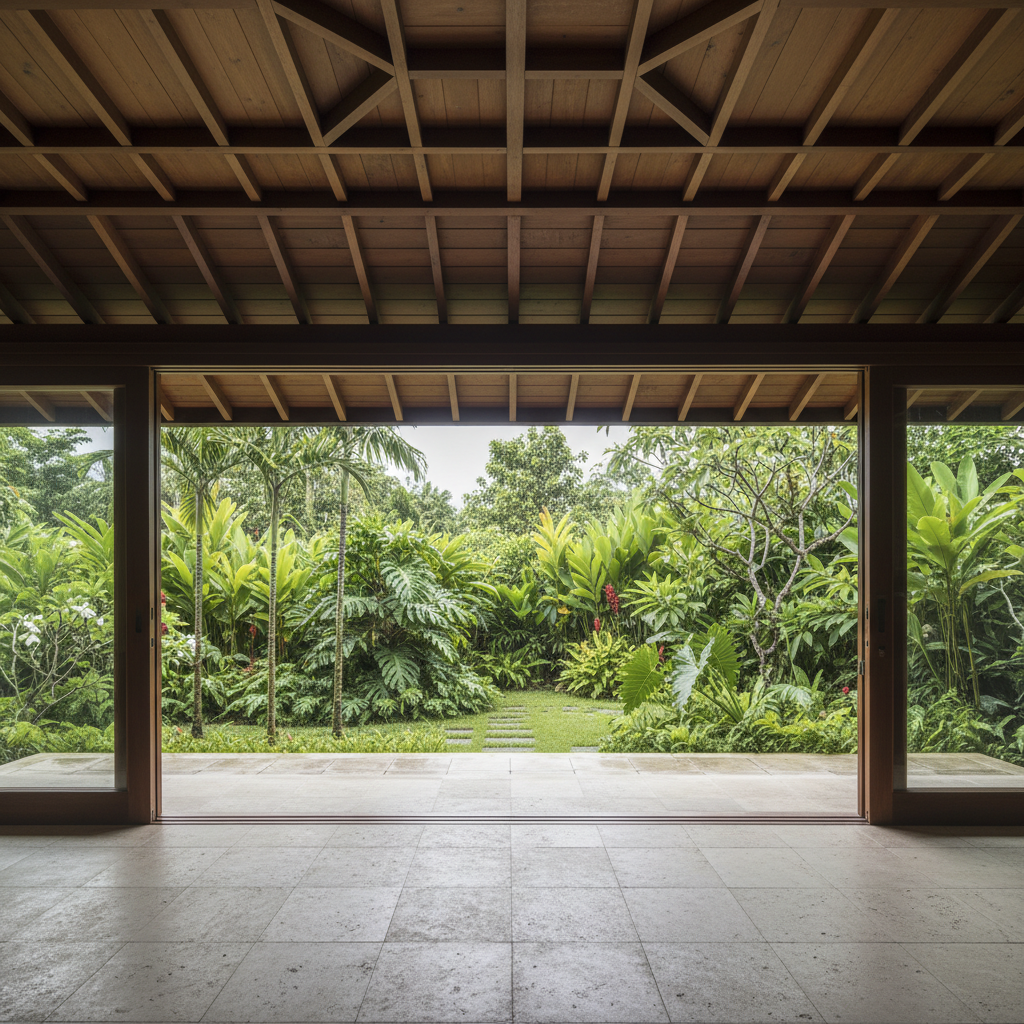
In a tropical climate, privacy cannot rely on opaque walls alone. The heat and humidity demand openness—cross-ventilation, shaded edges, and a connection to the outdoors. The courtyard resolves this contradiction. It creates a protected outdoor room that is visible only from within the house, turning the villa inward while still breathing with the landscape.
The first decision is orientation. A courtyard placed between the entry and the main living volume establishes a threshold—a pause that separates public from private. Visitors arrive, cross this open space, and only then enter the interior. The sequence itself becomes a privacy device: the house does not reveal itself all at once.
Privacy Begins with Orientation
I place the courtyard on the side of the villa that faces neighboring properties or the street. This shifts the main living spaces away from the boundary, using the open-to-sky volume as a buffer. The courtyard walls are high enough to block sightlines from outside, yet the space remains open above—allowing rain, breeze, and changing light to enter without compromising seclusion.
The effect is that the villa’s most private rooms—the master bedroom, study, or family room—look into the courtyard rather than outward. The view is not of a neighbor’s wall but of sky, foliage, and water. Privacy becomes an experience of depth, not enclosure.
The Courtyard as Filter
A courtyard also filters sound. In dense tropical neighborhoods, noise from traffic or neighbors is softened by the open volume. The hard surfaces of the courtyard walls reflect sound upward, and planting absorbs the rest. The result is a quiet zone at the heart of the villa—a condition that no solid wall alone can achieve.
Light, too, is filtered. Direct tropical sun is harsh; the courtyard diffuses it. Deep overhangs, trellises, or a single tree cast shifting shadows across the floor throughout the day. This movement of light is not decorative—it is a measure of time and temperature, a quiet rhythm that makes the house feel lived in.
Sound, Light, and Microclimate
The courtyard also creates its own microclimate. Cool air settles at night; warm air rises and escapes above. This natural convection reduces reliance on mechanical cooling. In a tropical villa, this is not a luxury—it is a necessity that the courtyard makes possible while maintaining complete privacy.
When designed with discipline, the courtyard is not an extra space to be filled with furniture or decoration. It is the organizing void around which the villa’s private life revolves. It gives the house a center, and that center is invisible from the outside.
Related Articles
Have a Project in Mind?
We work selectively with clients who value thoughtful, intelligent architecture.
Start a Conversation