Why Courtyards Work in Tropical Villas
A courtyard is not just an outdoor room; it is a climatic device, a privacy screen, and a generator of calm. In tropical villas, it transforms how air moves, light falls, and life unfolds.
In this article
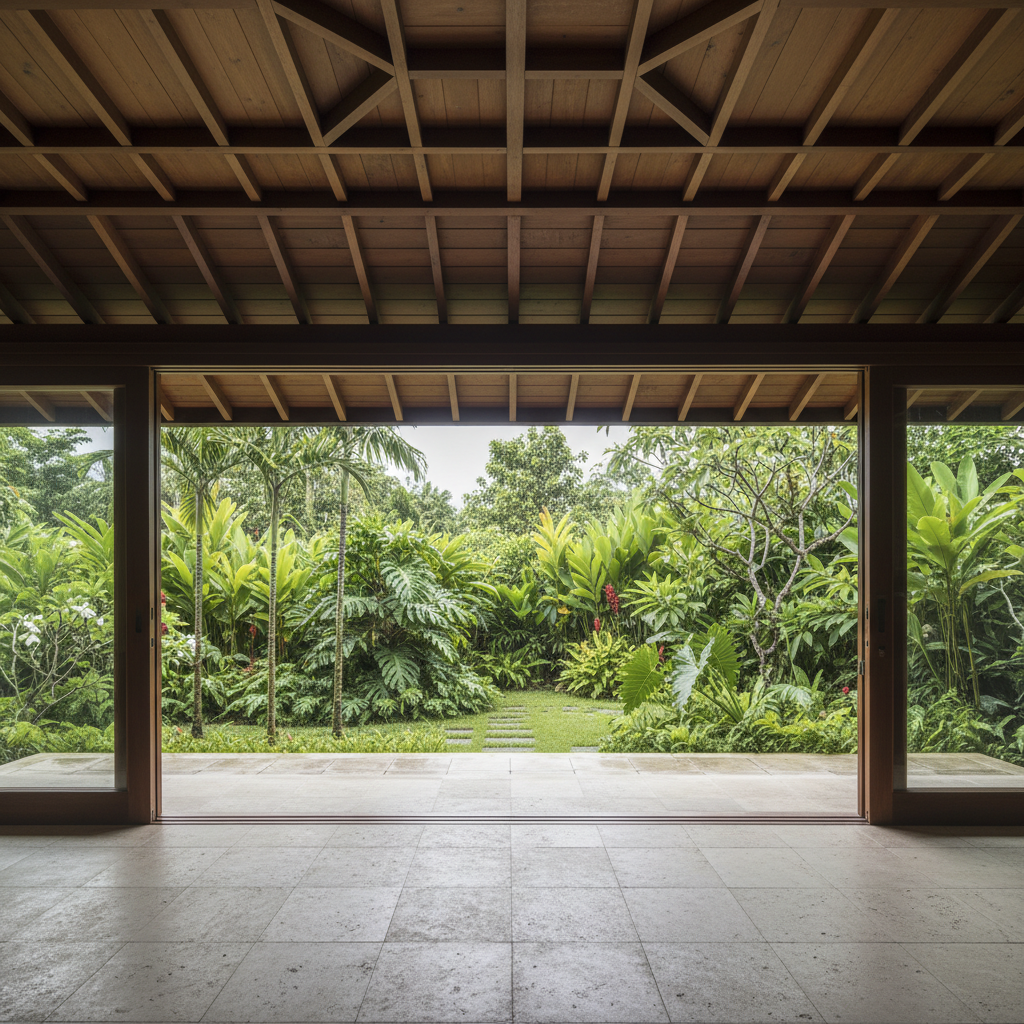
In tropical climates, a courtyard is not decorative. It is a response to heat, humidity, and rain. We place it at the center of a villa because it pulls air through the plan. Openings on opposite sides of the courtyard create cross-ventilation without relying on mechanical systems. The air moves naturally, cooling interior spaces before they become uncomfortable.
The courtyard also manages rain. In the wet season, it becomes a drainage point; in the dry season, it collects light. This dual role makes it practical, not ornamental. A well-proportioned courtyard — typically 1:1.5 width to height — stays shaded enough to remain usable throughout the day.
Climate First
We design courtyards to control microclimate. The walls cast shadows that shift with the sun, cooling adjacent rooms. Plants inside the courtyard release moisture through evapotranspiration, lowering the air temperature by several degrees. This is passive design, not technology. It costs nothing to run and requires only thoughtful orientation.
The floor of the courtyard is often finished with stone or gravel that absorbs heat slowly. Water features, if used, add evaporative cooling. But even without water, the courtyard works. The key is proportion and orientation — a narrow courtyard facing east receives morning light but avoids the harsh afternoon sun.
Privacy Without Walls
A courtyard creates privacy without fortress-like boundaries. Instead of high fences that block views and air, the villa wraps around an internal void. Every room opens onto this space, yet the outside world remains invisible. The courtyard becomes the visual focus, replacing distant views with a controlled, intimate landscape.
This is especially important on narrow sites or in dense urban areas. The courtyard allows a villa to feel generous even when the footprint is tight. It replaces the need for side setbacks, freeing up the plan for better spatial flow.
Light and Shadow as Materials
In tropical architecture, light is not something to flood a space with. It is something to modulate. The courtyard filters sunlight through trees, overhangs, or perforated screens. The result is a soft, dappled light that changes throughout the day — never harsh, never flat.
Shadow becomes equally important. Deep overhangs and solid walls create pockets of darkness that contrast with lit areas. This play of light and shadow gives rooms depth and calm. It is a quality that cannot be faked with artificial lighting.
A Sequence of Arrival
The courtyard also structures the experience of entering a villa. We often place it after the entrance threshold but before the main living spaces. This creates a moment of pause — a transition from public street to private domain. The visitor moves through a compressed entry, then opens into the courtyard. The shift in scale and light signals arrival.
This sequence is not accidental. It is the first spatial decision we make. It sets the tone for the entire villa: quiet, controlled, and responsive to climate.
Related Articles
Have a Project in Mind?
We work selectively with clients who value thoughtful, intelligent architecture.
Start a Conversation